

There is a running joke in my family – they say I can go without food but not without a book to read. And it is true. I remember on a Saturday, not long ago, driving around the city with them in the car, to find a book (not even my first choice) so I have something to read before bed and when I wake up. For me, reading is an intrinsic need. It helps me process my emotions, be an empath, understand the complexity of a different culture and situation, recognise my privilege. In other words (pun intended), a book always gives me something to think about. Most importantly, it sparks imagination – what the character looks like, how they would behave in real life, am I this person or could they be my friend – and creates a safe space for me to explore (my) moral dilemmas.
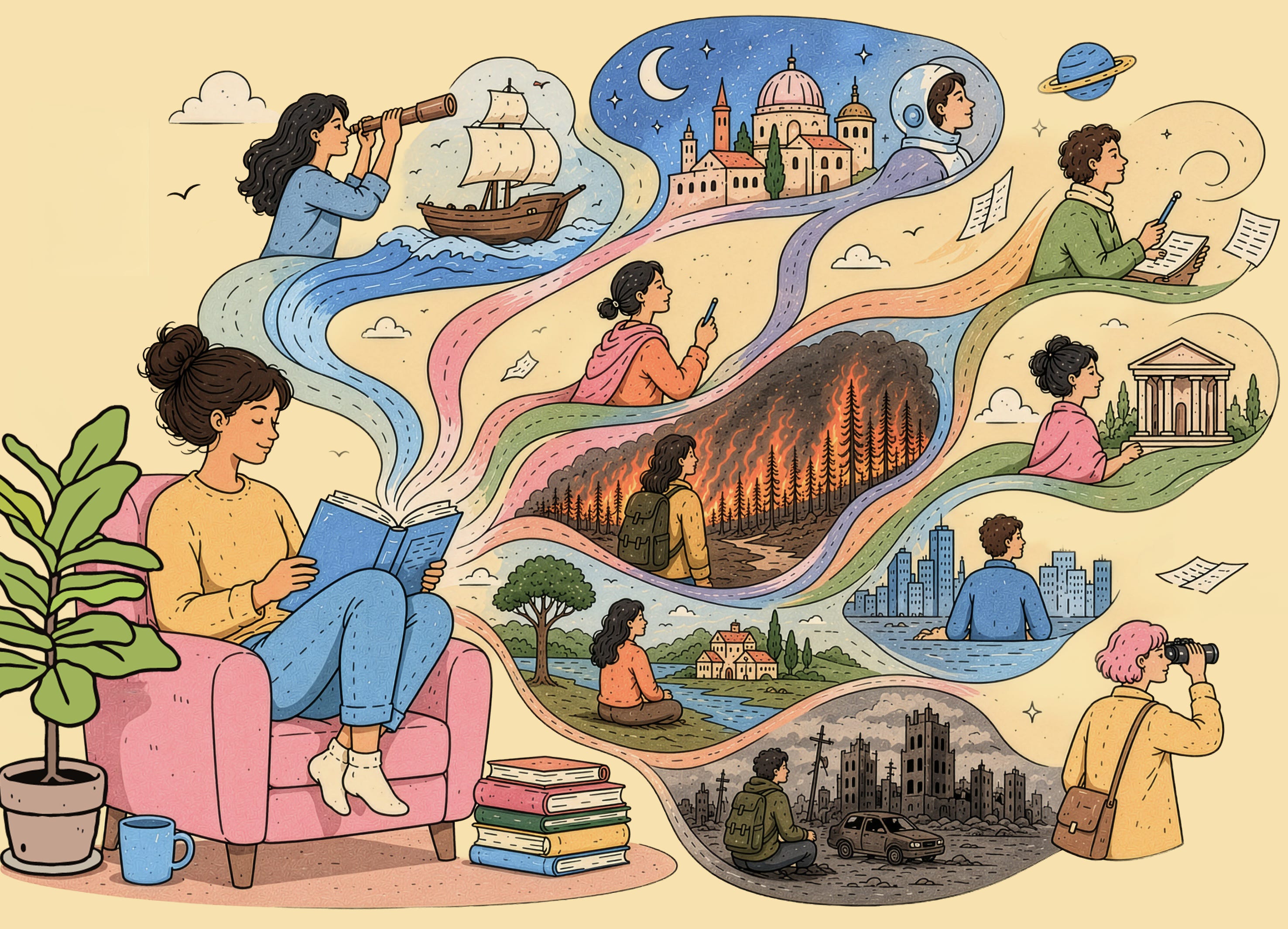
What comes without surprise is that I recognise an intentional design psychology in books and especially fiction.
Intentional design psychology contrasts existing manifestations of designers or psychologists clunkily putting together the two (design + psychology) to please users, create comfort and ‘humanise’ design. In opposition to the improv-version of design psychology that has been around for several decades, intentional design psychology is an ideological approach that deeply evaluates the damage both design and psychology have caused to social, physical and natural environments by being aligned with the status quo. It makes evident their collaboration in everything we do by designing the conditions we exist in and the behaviours and feelings that follow. It goes beyond the silos of disciplines to explore how we can redesign the way we perceive our past, present and future through the lens of impermanence. This, so we can become more adaptive than reactive to the polycrisis, and open up to multiple subjectivities, with ‘we’ being simultaneously universal and unique, given one’s special circumstances.
Similarly to intentional design psychology, when a writer creates a storyline, they don’t push for ‘objective’ truths, neatly demarcate areas and exclude realities to fit the given ideological paradigm’s bill. What they usually do is put together elements from various moments in time and understandings of life, playing out various scenarios of how one would approach a moral conundrum. They challenge the reader to release themselves from their usual ideological positions and become the person they are ‘not allowed’ to be through the story. The latter makes the reader part of ideologies that don’t exist, invisible or rejected subjectivities and confronts what they take for granted: their constructed reality. Stories bend binaries, break rules and penetrate social constructs, often generating a new language that enables the perception of hidden realities. That frees room for new realities and subjectivities to emerge, grounded in what the given ideology tries so hard to conceal – unsettlement and opportunities for radical change.
To summarise, fiction intentionally designs ‘realities’ where we can experiment with various versions of life and subjectivities without being restricted by our One psychology (conditioned way of seeing things), making possible the liberating experience of imagining different modes of thinking and being, without fear, failure or judgement. The how is hidden in a new narrative that arrives while and after I read a book, always responding to an existing condition that affects me. The focus naturally turns to what is troubling me at the time and whatever I am reading gives me a new perspective of my situation.
Examples? So many. I have learned from Zorba the Greek and Nikos Kazantzakis how (to try) to live free of expectations; from ancient Greek tragedies how to expect imperfection, even from Gods; from Colson Whitehead and Bernadine Evaristo about the complexities of identity and injustice in a foreign land that is ironically called ‘home’; from Elif Shafak how to be a female inbetweener of cultures; from Elizabeth Strout the beauty of internal struggles; from Jonathan Franzen the consequences of the messed up individualism we’re all caught up in. The list goes on but each book that I’ve read, even a bad one, has been a catalyst of thinking creatively, unconventionally, otherwise.
I am lucky that my kids like books and libraries are our happy place. Yet, this is not a reality for so many kids around the world. They grow up in front of screens and/or without books, they don’t get exposed to them and they simply don’t read. In a developed country like Australia, I have experienced the downfall of reading books firsthand, through teaching at a university. It would go without saying a decade ago that part of the curriculum involved weekly readings in the form of scholarly journal articles and book chapters. These days, expecting students to read academic work on a regular basis is unthinkable. Reading Rose Horowitch’s piece in Atlantic about ‘The elite college students who can’t read books’ corroborated the information my small sample made evident. What (not reading) does to the brain is not an assumption, it is science – it shrinks the white matter.
This little window kids get to go wild with their imagination, create worlds that can’t be knocked down by reality and forge cognitive pathways to support their critical thinking as adults, goes wasted simply because they don’t read (or are not encouraged to read). Add to this the impromptu design psychology of Artificial Intelligence and the active encouragement that comes from a machine to not read and research, just digest a summary of what it put together. And then what? Who will this person be when they grow up? How will they deal with challenges and discomfort? How are they going to critically evaluate injustice, catastrophe, opportunity? How will they stop the world from falling apart?
I was recently asked while I was reviewing a scholarly paper if I wanted AI to summarise the paper for me. My first reaction was – what is the point? Why did the journal ask me to do the review in the first place? Despite how demoralising that felt, it made me think how I am better than AI because of all the books I read that have altered my brain in a way a machine cannot replicate.
So, what I put forward here is the intentional design psychology of reading as a response to the polycrisis; creating a space through storytelling that allows for life scenarios to play out, emotions to emerge and realities to be confronted before they happen. Not in a doom and gloom way but following the Stoic tradition of exploring options to be prepared.
I ask you to visit an actual bookstore or a library and feel the pages of a book; borrow or buy one and spend some time with it. Let it sink and make you think. Notice how it changes your perception of a single thing: habit, bias or ignorance. Then explore your emotions. Is there a new psychology added to the ones you carry with you? Was it born out of your imagination?
What I would add to Ruha Benjamin’s book Imagination: a manifesto is not only that imagination makes the alternative possible but also that it turns hope into action. Reading gives us the strength and courage through our bigger brains and hearts to envision and act on our desire for a better world, or at least that’s what it does for me. To quote Emma Staub’s bookstore name, ‘BOOKS ARE MAGIC’, and we desperately need that magic in our lives, right now.
I was listening to the How I Write podcast last week, and Yann Martel (author of Life of Pi) was asked to comment on the use of AI in writing, and he said "that to me would be like hiring someone else to have sex for you". This is honestly what I think of using AI in most contexts, but particularly reading.
I consider it high satire when my phone offers to summarise a text message. Why not just get my avatar and her avatar to have the friendship instead? Just think of all the friends I will have if I adopt this kind of efficiency.