
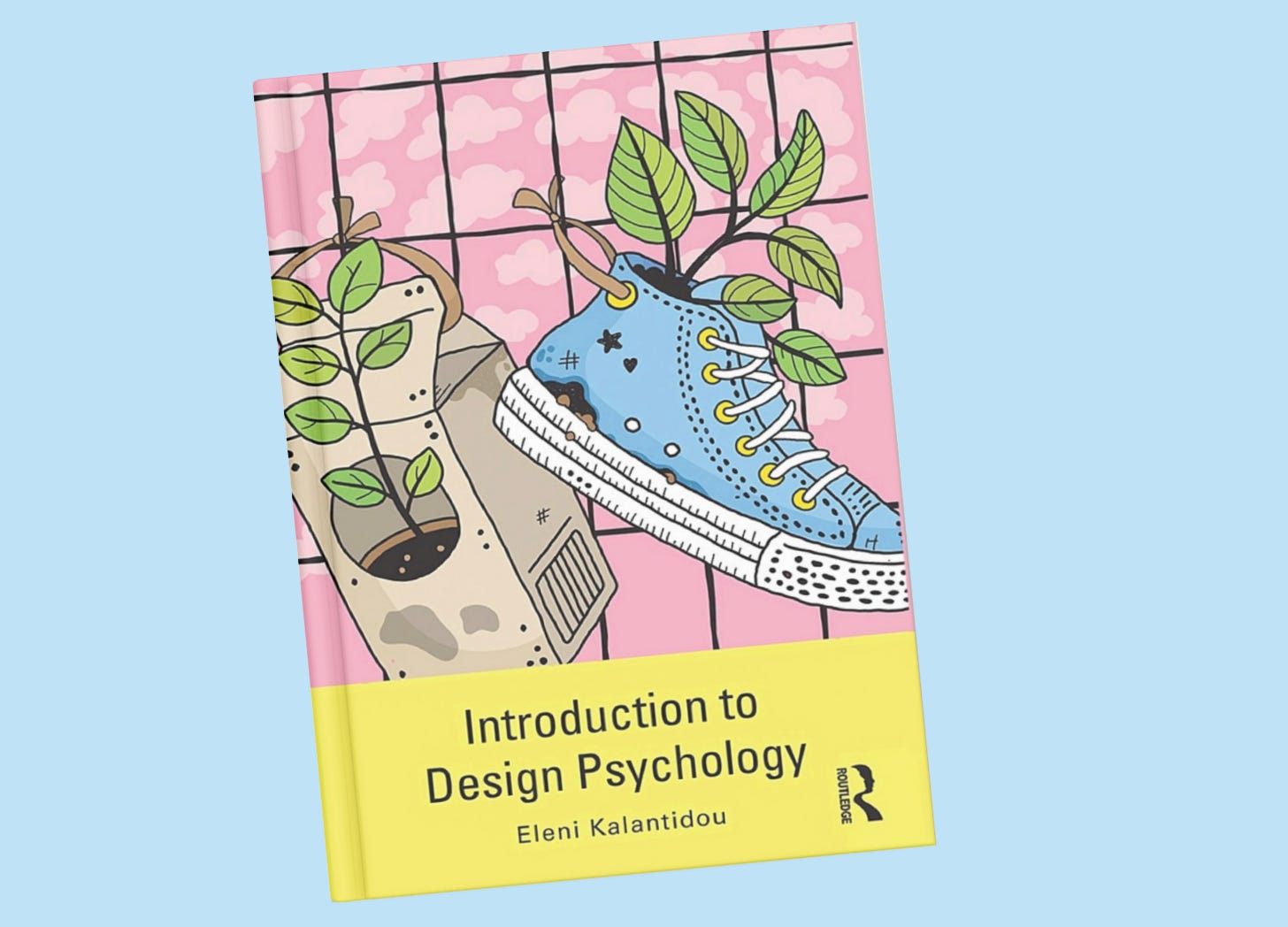
Introduction to Design Psychology
Author Eleni Kalantidou
Publisher Routledge
Abstract
In the age of climate change, psychology and design have been employed through impromptu collaborations to validate solutions and future scenarios.
Introduction to Design Psychology contests this approach by proposing an ideological framework for an intentional, joint endeavour between psychology and design. Intentional design psychology is presented as a critical proposal grounded in unpredictability, nominating ways to activate new production, consumption, and habitation patterns. It unfolds through chapters exploring urban environments, technology, and consumer culture, making evident the need for new definitions of social resilience and adaptation. As part of this process, adaptive designs that enable resilient psychologies are revealed. By challenging the disciplinary status quo of psychology and design, this book aims to activate a new field of knowledge.
Introduction to Design Psychology is essential for psychologists, designers, and urban planners, as well as professionals from affiliated fields, willing to reconfigure their own thinking and practice.
Author
Eleni Kalantidou is a design psychology theorist, strategist, researcher, and Associate Professor at Griffith University, Australia. Her research activities are focused on environmental and social resilience, design strategy, social impact, and social innovation. Kalantidou’s research on repair, community-led behavioural change, resilience, and adaptation has been published in books and journals and funded by grants and consultancies. As a researcher and consultant, she has collaborated with various international, national, and local non-governmental organisations, as well as the public sector.
Explore Eleni’s other publications & books here
Endorsements
“This subversive book challenges commonly accepted notions of stability and attachment to make a radical proposition that calls for care-fully embracing the axiologies of “Di/De”: Positive destruction, disassembling, detaching and discomforting are advocated as new epistemological and ontological orientations in the face of unsettlement, unhoming, and precarity. Bringing dominant approaches to design and psychology under scrutiny, and criticizing the pitfalls of their mutual trajectories of universalism, cartesian dualism, and scientification, Eleni Kalantidou reads the two fields in conjunction with each other urging us to overcome their misconceptions and malpractices while restoring their potency of transformation.”
Jilly Traganou
Professor of Architecture and Urbanism, Parsons School of Design, The New School
“Psychology is intrinsic to design practice, is elemental in acquiring a design habitus, and is mobilised in numerous environmental contexts. Yet for all this, design psychology mostly resides in the domain of the unthought. So, what exactly is it? How should it be understood? And, how can it be moved directly into the consciousness of designers, and with what consequence? Eleni Kalantidou’s informative and challenging book provides the means for designers to answer these questions.”
Tony Fry
Adjunct Professor of Architecture and Design, University of Tasmania
“For years, critical academics have argued that the discipline of psychology must learn about mental life by including the psychological humanities. Eleni Kalantidou thoughtfully expands the boundaries of psychology and demonstrates that psychology and design studies mutually invigorate their theories and practices. This relevant book is thoughtfully articulated and convincingly affirms that design psychology is a program that deserves significant intellectual and applied attention.”
Thomas Teo
Professor of Psychology, York University
Reviews
"Design Psychology is a tantalising text, offering inspiration rather than tried-and-tested methods. But as a critical dismantling of current orthodoxies and “a new design paradigm to enable the transition to new psychologies,” it is an inspiring book...in its density, it offers great material for further development, and a determined reader will be rewarded with many, many green shoots to nurture and grow".
Peter A. Hall
Reader in Graphic Design at Camberwell College of Arts, University of the Arts London, UK
“Review of Introduction to Design Psychology by Eleni Kalantidou”
She Ji: The Journal of Design, Economics, and Innovation, Volume 11, Issue 4, 2025
"This is a very important book that introduces an entirely new way of thinking about Design Psychology in the Anthropocene, and it is filled with many moments of discomforting pleasure as you realise how much there is to learn, and unlearn".
Cameron Tonkinwise
Professor of Design Studies in the School of Design, University of Technology Sydney, Australia
”Book Review: Introduction to Design Psychology by Eleni Kalantidou”
Design and Culture, 1-4, 2025
Contents
Introduction
Chapter One: Setting the Scene for Design Psychology - Where From and Where To?
Design Psychology: Where From?
Ontologically Situated Psychology and Design
Epistemologically Situated Psychology and Design
The ‘Scientification’ of Psychology and Design
Psychology as a Science
Critiquing the Natural-Scientific Model and Modern Psychology
Design as a Science
Critiquing the Natural-Scientific Model and Design as a Science
Psychology and Design
Psychologies and Designs
Chapter Two: Psychology and Design - An Opportunity for Change
Impromptu Design Psychology
Defining Impromptu Design Psychology
Cognitive Psychology and Design
Behavioural Psychology and Design
Design and Emotion
Impromptu Design Psychology as a Response to Social and Environmental Challenges
Impromptu Design Psychology and User-Centred Design
Intentional Design Psychology
Plural Psychologies and Designs
Place-Based and Lived Experience Approaches
Design Psychology: Where To?
Chapter Three: The Design Psychology of Urban Environments
The Evolving Relationship Between Cities and Psychologies
Urban Schizophrenia
The Urban Psychologies of Housing Precarity
Psychologies of Displacement
Designing Psychologies of Adaptation
The Technocratic Approach
The Degrowth/Commoning Approach
The Just Transitions/Green New Deal Approach
The Intentional Design Psychology of Adaptation
Chapter Four: The Design Psychology of Technological Dependence
The Design Psychology of Technocracy
From Technê to Technology
From Homo Faber to Posthuman
The Design Psychology of Informational Revolution
The Role of Design
The Role of Psychology
The Role of Design Psychology
The Intentional Design Psychology of Critically Living with Technology
Chapter Five: The Design Psychology of Waste
The Condition of Waste
The Making of Consumer Culture
The Sociology and Psychology of Consumer Culture
The Design of Consumer Culture
The Design Psychology of (Un)Happiness
Steps Toward Redemption: Design, Psychology and (Impromptu) Design Psychology
Design
Psychology
Impromptu Design Psychology
The Verdict
Repair As Intentional Design Psychology
Learnings From Lived Experience for Intentional Design Psychology
Chapter Six: Intentional Design Psychology - An Introduction
Intentional Versus Impromptu Design Psychology
Di/De- with Care
Detaching
Destroying
Disassembling
Discomforting
Intentional Design Psychology: A Loose Ideological Framework
Bringing Psychology and Design Together
Disrupting Normality
Community-Led Behavioural Change
Handling Fr/Agility with Care
Epilogue
Next Steps