

I need time to function, think, process my feelings, keep myself in check, overcome my short fuse and fight or flight tendency. Yet time is an illusion. What gets prioritised daily is doing, not being. This entails urgency: to work/be productive, first and outmost, while also juggling hands-on parenting, wealth making, exercising, and when possible, socialising. This stress-induced lifestyle keeps me self-involved, time-confused and detached. News comes and goes about places that have already run out of time, people that are experiencing catastrophe without alternatives, mortgages and rates going up, up, up. The priority is not them; it’s me. My microcosm is dictated by emails, school runs, relationship dynamics, dealing with other people’s egos and insecurities. Nowhere in this picture is there a time for an actual we.
‘We’ exchange snapshots of our everyday survival mode, whatever that means, depending on our level of privilege.
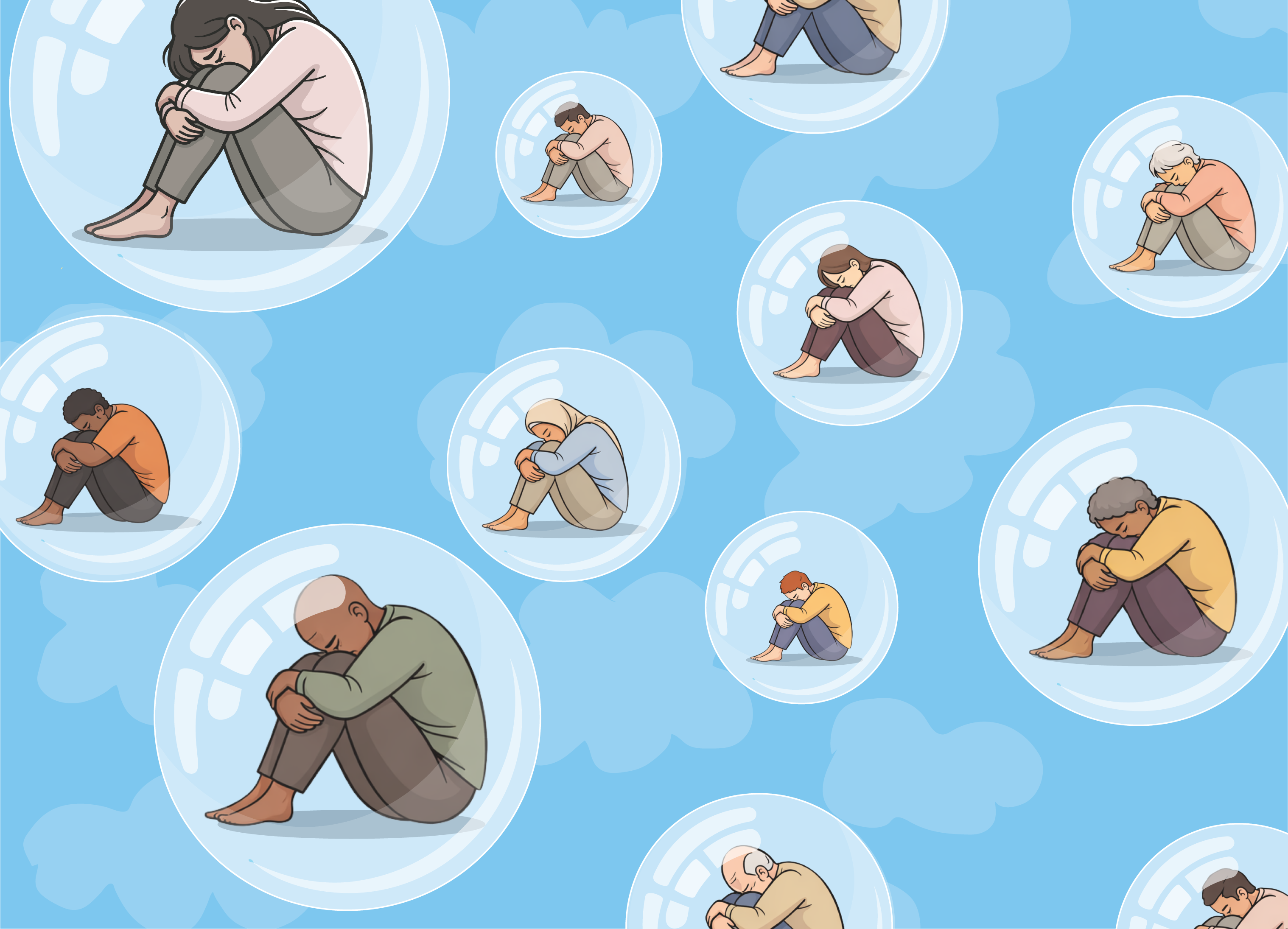
Our individualism, dissociation and heightened self-importance are by design. Our neighbourhood is full of strangers; we don’t have a village to help with life and our co-workers are competitors. Why? A quick answer would be Modernity, a more elaborated one, would be the breakup of kinships and de-familisation of society by separating family from economy1. Both entail a blueprint of transitioning from living together, making collective decisions and relying on the commons2 to being alone, not talking to anyone due to heightened feelings of not-enoughness, competition paranoia and carrying the burden of everyday grind. These align with what Georg Simmel3 identified in the beginning of the 20th century as structural loneliness, which comes out of urban life being designed to break down communal ties whilst simultaneously hyping individualism as independence.
In action, the by design part comes into play though examples such as the grand domestic revolution that never happened4 and the dismantling of unions with more recent examples being the American corporate union busting led by companies like Amazon Starbucks, and Trader Joe’s. That said, if we could reverse the latter design by collectivising workers’ rights, we could fight both the oligarchy of billionaires by activating “progressive taxation and mass unionization” and bring people together (killing two birds - wealth concentration and social isolation – with one stone).
Now that we established how individualism came into play by design and how it impacts our psychologies, let’s trace the design psychology of how our current ideological and economic mode (late capitalism) convinces us that individualism is a good thing and - drum roll plus dramatic pause - we can fix ourselves. Perhaps, it would have been a better professional pathway for me to become a life coach when I graduated with a psychology degree than going down the academic path because in the past two decades, personal well-being has exploded. Well-being sites, experts, services and retreats are all the rage if we want to be on top of our happiness, success and performance in all walks of life. They tell us how to rewire our brain, eat better, and break the pattern of self-destruction. Meditation is back and not just for the hippies. Despite the myriad beneficial aspects of being not doing, learning how to regulate our nervous system and sitting with our emotions, its teachings emphasise the I not We.
Bell hooks eloquently put it:
“I am often struck by the dangerous narcissism fostered by spiritual rhetoric that pays so much attention to individual self-improvement and so little to the practice of love within the context of community.5”
Change begins from the self, for sure, but it does not escalate to the collective, if we don’t confront the systems that tear us apart. For example, Dan Harris promotes the idea of a ‘community’ through participation to events, Q & A, and online meditation but not sure if his or similar efforts have led to actual collectives, mutuality and interdependence. Metta (in Pali) or love and kindness practice is rightfully prescribed as an antidote to fear by Sharon Shalzberg but how much of it extends to building profound connections with other human beings?
The advice well-being sites provide for ‘social health’ is very similar to individual behavioural change. It’s my job to change how I connect with other people in an isolated world. It’s my responsibility to break the barriers of time poorness despite working to meet my financial obligations and the pressure to perform in an economy that can no longer grow. I need to put the effort to breathe like a monk, eat like a millionaire, exercise like an elite athlete, and afford therapy, silence retreats, holidays and access to nature. Blueprints for longevity are only applicable to people with money, time and private healthcare system access and notwithstanding their useful research and advocacy for preventative healthcare, they sit at the opposite end of de-fund public health systems. Who has the time and resources for all this? How much more exclusive and individualistic this experiment should get to realise that we, the lucky few, are self-indulging while our systems (political, economic, social, technical) are failing us. On top of this, we have stopped talking to real people and started talking to AI bolts, designed to never disappoint us, push back or tell us the truth.
The divide will deepen, if optimisation is on offer only for the individual and does not actively extend to building collectives. Pursuing self-betterment derives either from standards that are not ours to begin with, or from our need to fix the symptoms of a broken system. None of the well-being websites is truly contesting the context from where depression, bad diet and anhedonia derive, because they cannot repair what keeps us in isolation and are helpless to address the source of our problems (bad governance, ruthless economy, polarised societies, declining climate). The systems that keep us separate simply don’t get confronted.
We are trying to figure out how to live longer and better without acknowledging the elephant in the room – we are subjects of abandonment, in conditions we cannot control.
Please let me elaborate on the above statement. Yes, we want to live and feel better. And we potentially see mental and physical health results when we try to optimise our lives. But how can we sleep when our beds are burning6?
Climate change is present and real, environmental conditions are getting harder, species are dying and food production is greatly challenged. Despite the many little bubbles of activity, we do nothing. The enigma of climate inaction7, has been explored in so many ways – environmental psychological, economic, sociological and the list goes on. Theories provide bottom-up (degrowth), or top-down (the Green New Deal) fixes, rarely a combination (just Transitions) and commonly an approach related to the specialty of the expert/writer/researcher. Their suggestions hardly reach the affected, who struggle, deny or surrender to nihilism, depending on where they are on the spectrum of climate change impact.
So what works? (spoiler alert, collectives).
From what we’ve seen so far, predictive modelling does not work but community self-organisation and commoning, the practice of self-governance and collective decision making regarding the distribution of resources, does. As a response to individual behavioural change, community-led behavioural change is rooted in change led by place-based lived experience that identifies strengths and weaknesses on the ground and how resources can be maintained and distributed. Small pockets around the globe and especially in contexts of environmental and/or political crisis showcase how agency can be reclaimed and activated amongst people at risk. I step away from the concept of community8 due to its weaponisation for polarising purposes such as reinforcing nationalism, racism, sexism etc. and put forward the idea of constantly changing configurations of subjectivities.
We don’t have to join forces because we are the same but because we are in conditions we either want to protect ourselves from or make better. Migrants crossing the Mexican border to the United States come together because they have a better chance of first survival and then success; they’re not friends, but in the moment, they share what’s at stake. In this context they become one instead of distinct units lumped together9. The same urgency is required for climate change. How?
Grow alternate psychologies: We all share the same psychological state (One psychology) that has not served as well. Why? Because it nurtures attachment to expectations from life that won’t be met (materialistic happiness and success, stability and permanence) and fosters blame as a response when they don’t. Accepting impermanence as a given (detachment), makes possible an agility in thinking and doing that right now, is not available. Understanding systems and how they operate to reinforce One psychology frees us, as individuals, from the heavy lifting and self-blame for everything that’s wrong, and enables accountability mapping, the practice of who/what/why is responsible for every aspect of our lives. Ideologically, spatially and practically removing what is harming our chances for extending our future (affirmative destruction) will allow for psychologies (plural) to emerge so we can accept and negotiate loss, opportunity and change.
Find knowledge outside conventional knowledge: this entails accepting there are no solutions (permanent and fixed) and truth is a social construct grounded in epistemological colonisation (See Eurocentricm & Modernity). The way knowledge is currently addressed and pursued is within the confines of outdated models of understanding the world and failed economic theories (See privileged white old men’s theories and GDP as prosperity, respectively). These barriers need to break starting with opening knowledge to unaccounted traditional and indigenous knowledges; critically evaluating what/where knowledge is produced and what is taught at universities and schools.
Become relationally accountable: going back to Modernity, individualism and knowledge, they all share the same attribute: thriving in and reinforcing silos. Making relationality part of how we operate brings back accountability into the big picture. Commoning, co-ops, indigenous custodianship become the paradigm of how relational accountability works and the impact it has on all living beings.
Demand participatory governance: community-led behavioural change has showcased that when constantly changing configurations of subjectivities come together for a short or long stint to work on a shared cause, magic happens. Scottland’s citizen assemblies, decentralised renewable energy transitions in sub-Saharan Africa and Indonesia’s village law are just a few of examples where, without being perfect, participatory governance takes place. In all these cases, collectives make decisions about their present and future together, directly addressing their food, habitation, transportation, access to facilities and how money is spent for their benefit. Despite the ongoing effort of governments to offload services to NGOs and citizen collectives, participatory governance is also about demanding services relevant to needs on the ground and planning irrelevant to political cost.
Implementing these ideas might bring to life not only a chance for a future but a profound connection with fellow human and animate beings, similar to how my youngest daughter calls all little people ‘friends’.
Now you know my friend and the clock is ticking. We better get started.
Macfarlane, A. (1992). On individualism. In Proceedings of the British Academy (Vol. 82, pp. 171-199).
Ostrom, E. (2008). Tragedy of the commons. In The new Palgrave dictionary of economics (pp. 1-5). Palgrave Macmillan, London.
The metropolis and Mental Life (Die Großstädte und das Geistesleben) was written and published in 1903.
The 19th and 20th century movement of radical feminists that fought against the patriarchal imposition of the isolated nuclear household, which, to this day, enables unpaid labour and prevents sharing chores like kid rearing and cooking for women (Hayden, 1982).
bell hooks (2001) All about Love: New Visions. Perennial, New York.
Lyric from the iconic Beds are Burning song by Midnight Oil (1987).
Referring to Frederic Samama’s book with the same title.
Kalantidou, E., & Hay, N. (2023). Community in a Changing Climate: Shaping Urban and Regional Futures. In The Palgrave Encyclopedia of Urban and Regional Futures (pp. 340-346). Springer International Publishing, Cham.
Díaz de León, A. (2022). “Transient communities”: How Central American transit migrants form solidarity without trust. Journal of Borderlands Studies, 37(5), 897–914.