

I don’t know if it is serendipity but the last two books that I read negotiate the same thing: trying to create happiness, feeling voids and ‘curing’ past trauma via material things. Matt Haig’s ‘The Midnight Train’ and Dr James R Doty ‘Mind Magic’, share stories about difficult beginnings, journeys of overcompensation, wild success and respective emotional failures. The former story is fiction and the latter is true. What they hold in common is the intention to succeed based on the late capitalism model. Prosperity in the form of wealth. I don’t want to give too much away but, in both cases, there is an aha moment where ‘all that is solid melts into air… and man is at last compelled to face with sober senses his real conditions of life, and his relations with his kind1’. In other words, the fictional and real character, respectively, are faced with the conundrum ‘money is success but doesn’t bring happiness’.
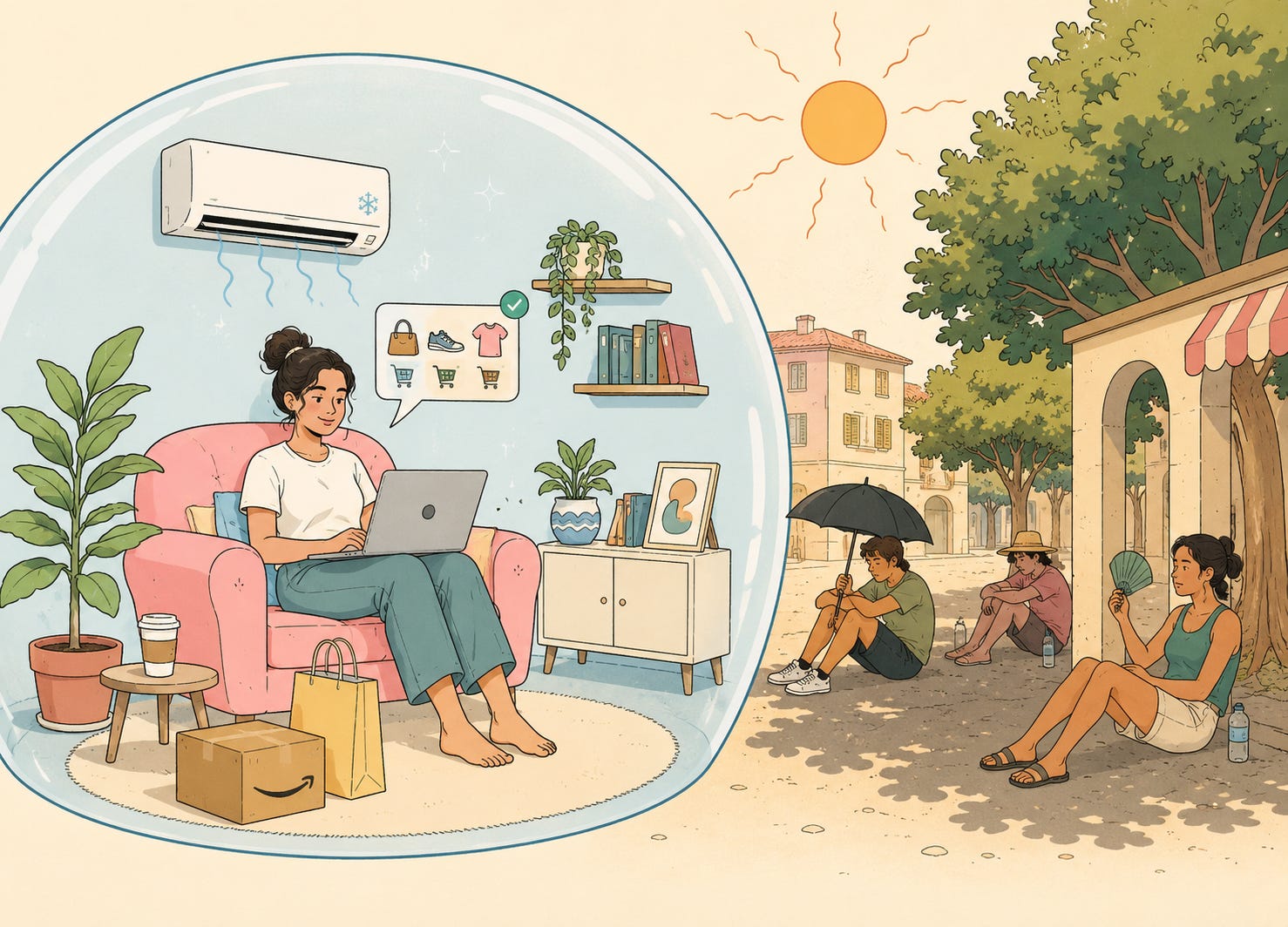
Why is that? From the outside, interpreting material prosperity as success might look as the arbitrary aftermath of Modernity. However, it was properly designed to fill in the gap of retreating from colonialism and conflict as a means of economic growth for countries such as the United Kingdom. United States found a clever way to perpetuate it via ‘an impromptu design psychology of psychological obsolescence2’ (creating the desire to replace still functioning stuff with ‘better’ and ‘newer’ models) combined with ‘material obsolescence’ (stuff designed to last for a shorter period and being replaced within a limited timeframe). The ground was fertile in post-World War II America and Europe due to two centuries of transitioning from a producer to a consumer culture, which eventuated in homogenised tastes and corresponding behaviours. As a result, success received the connotation of concentrating wealth with the expectation of this leading to everlasting happiness.
Fast forward to the present, where economic growth is globally stunted or significantly slowed down, the concept of turning basic needs into products has escalated to health, mental health and education. We are up against not only working till our last breath to pay for these ‘products’ but also conditions such as social isolation and dying alone in retirement homes. Sounds disheartening but it is the truth. Reaching the promise land of ‘success’ and ‘happiness’ is an illusionary state that has consistently trapped generations in a hamster wheel, unable to step off, leading to record percentages of loneliness, depression and anxiety as well as psychiatric disorders such as compulsive gambling and buying3.
Back to the design psychology behind the fabricated intention of success and happiness, it has been designed to mentally position humans in an individualist state where they can control their ‘success’ and ‘happiness’ by working hard and buying stuff. The conditioned chase for internal and not external gratification only serves a flawed model of economic growth and has as a major side-effect dissociation from interference with nature and the collective. In the case of the fictional and non-fictional characters in the books mentioned above, their intention to become the ones that society idealises led to removing care from their loved ones, their natural and social environments, the benefit of all living beings.
From a philosophical point of view, internal gratification is aligned with hedonism, the pursue of own’s pleasure just for pleasure’s sake and external gratification is in step with eudemonism, where the driving force behind action is the achievement of virtue and well-being for all humanity. Interestingly, despite the notion that eudemonism is all about the good stuff, lots of disciplines have taken advantage of it to promote their own agendas, including design. Eudemonic design is yet another example of well-meant intentions translated into marketing jargon, unrealistic goals for the individual and designs that in real life can never be achieved by design alone. So how do we move from conditioned lifestyles, desires and perceptions of ideal life? And by ‘we’ I mean the privileged (white) people that can buy stuff and make waste.
As a point of departure, I’d like to propose repair as intentional design psychology. In this instance, repair does not take the traditional form of fixing stuff but the self and the community too. This entails recognising the loss of care and responsibility for preservation skills, transgenerational knowledge of mending and maintaining, and more crucially, learning from the past and preparing for the future. The disconnection from the old imposed by the impromptu design psychology of late capitalism has enacted a freedom to abandon the idea of roots, literally and metaphorically. Elders are being placed in homes, environments are disconnected from food production and seasons, and repair is replaced by cheap buys. The acceptance of all the above, was made possible by the consumer culture enabling service economies of obscureness and a psychology of uncritical compliance.
Why now? The myth of abundance perpetuated by supermarkets stocked by goods from all over the world 12 months a year, is soon to be debunked by climate change significantly disrupting food production. Supply chains, as seen with COVID-19 and more recently the Ukraine and the war in Iran will gradually get more and more unreliable. The concept of ‘service’ will be greatly challenged in conditions of environmental disasters and unpredictability. If you don’t believe me, you might believe Samantha Burgess, Strategic Lead for Climate at European Centre for Medium-Range Weather Forecasts (ECMWF) stating that
“June 2026 underscored how profoundly the climate is changing. Western Europe recorded its warmest June on record, and continued record warmth in the global ocean. Together, these records reflect a climate system continuing to accumulate heat. The result is increasingly intense heatwaves, a persistently warm ocean, and growing risks for people, ecosystems and infrastructure across Europe and beyond4”.
Still, if you google ‘European Summer 2026’ you get vacation hotspots and stats about the World Cup.
Why intentional design psychology?
Design and psychology have played a huge role in contributing to the mess we’re in. And despite the ‘we’, we are (not) all in this together. The discrepancy between resources and access to them will grow bigger and the division between those with options and not will become wider. The continuation of an ideological and economic paradigm faith from governments that currently enable tech bros to make things worse via AI farms and irreparable damage requires bottom-up responses that redesign the psychology of uncritical acceptance to psychologies of agency and interdependence.
How?
Commoning and community-led behavioural change: the Right to Repair movement has shown how a bottom-up approach can influence policy, make tech-companies change their repair regulations and make people interested in repair, again.
Reverse-engineering psychological and built-in obsolescence: collectively deconstruct the designs that have enabled internal gratification by turning functioning items into waste. Then recompose psychological resilience via skilling, transgenerational exchange of capabilities and maintenance of resources via reuse, sharing and repairing.
Commoning and repair: ‘repair in common’ by sharing skills and capabilities; ‘repair for the common’ by collectively using repaired resources and ‘repair of the common’ by maintaining resources5.
Community economies and politics of care: redesigning systems by drawing from how care is practiced in community economies, emphasising the psychologies of precarity, impermanence and fragility as resilient and adaptive. In this regard, not knowing does not become pathologised as anxiety for the future but becomes fuel for preparation and prevention, inspired by care models.
In a nutshell, to replace the consumer culture with mindful repair (of the self, ‘community’ and stuff) we need an intentional design psychology where design is directed toward valuing fragility and impermanence, supporting and supported by psychologies of care.
More than ever, care as “necessary yet mostly dismissed labours of everyday maintenance of life, an ethico-political commitment to neglected things, and the affective remaking of relationships with our objects6” becomes the connective tissue that supersedes recklessly surrendering to a dream that will never materialise (materialist happiness).
From Karl Marx and Friedrich Engels’ Communist Manifesto (1948).
See Vance Packard’s The Waste Makers (1960).
Barbieri, G., Mosto, G. & Rogier, G. Materialism and Compulsive Buying: A Systematic Review and Meta-analysis. Int J Ment Health Addiction 24, 1938–1966 (2026). https://doi.org/10.1007/s11469-025-01478-2
Copernicus: Record heatwave brings hottest June for western Europe during second-warmest June globally https://climate.copernicus.eu/copernicus-record-heatwave-brings-hottest-june-western-europe-during-second-warmest-june-globally
Paraphrased from in, for, and of the common (Nieto-Romero, M., Valente, S., Figueiredo, E., & Parra, C. (2019). Historical commons as sites of transformation. A critical research agenda to study human and more-than-human communities. Geoforum, 107, 113–123).
Quote from page 100 - Puig de la Bellacasa, M. P. (2011). Matters of care in technoscience: Assembling neglected things. Social Studies of Science, 41(1), 85–106.