

I was cycling around my neighbourhood this morning and there was debris everywhere; mattresses stacked on each other, tv screens, chairs, toys and whatever is not wanted anymore. These items are sitting by the side of the street, waiting to be picked up and disappear. Out of sight, out of mind. Once removed, they will get transported to a dumping site, where they will get decomposed and gradually release whatever toxic substance is hiding in their materials. Of course, the plastic won’t go away, and it will be buried under tons of ‘waste’, a cultural connotation given to things that often can be repaired, reused, repurposed, upcycled and lastly recycled. The ease by which these things get disposed is by design. They will be effortlessly replaced by new ones, and their owners won’t think twice about them once they are gone because they will quietly disappear, thanks to an urban infrastructure of invisibility paid in the form of tax or council rates by the foresaid owners. This impromptu design psychology (throwing away stuff and not feeling bad about it because they are going away never to be seen again) keeps capitalism alive.
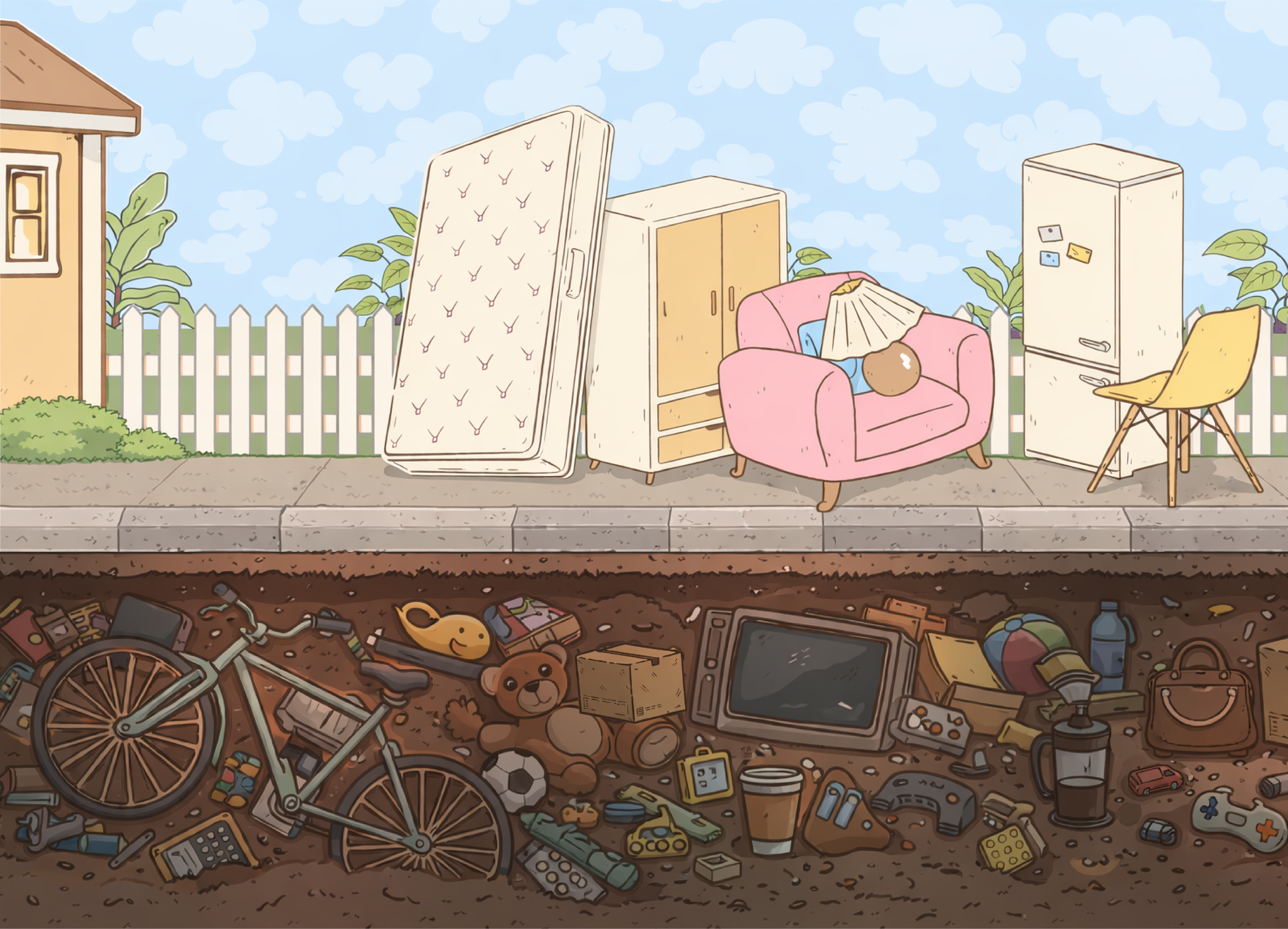
Turning everything prematurely into waste, then making it vanish in thin air, only to turn around and buy more is a luxury on par with Global North’s urban environments. Despite the growing disparity these cities are currently experiencing, with social injustices multiplying due to cost of living, rising house prices and consequent homelessness, they are hopelessly trying to maintain a faux façade of prosperity so people can continue to consume. Malls and shopping centres are just a heartbeat away to replace with new, the ‘waste’ that the visible and invisible infrastructure removes. What is added to this very problematic choreography is the invisible infrastructural repair (if the city can afford it) either caused by wear and tear or natural disasters (floods, wildfires, hurricanes), which enhances the false perception of the city as stable and safe. The connection between the three (waste, natural disasters, damage) is usually ignored, so the dancers continue to follow the choreography’s steps.
Unfortunately, the dance will soon resume because:
a. climate change will make damage more imminent in Global North cities and the cost of fixing it harder
b. housing, which is already a major issue, will grow in price and will become uninsurable, if not already
c. a+b will disrupt buying power therefore the broken won’t be easily replaced anymore.
Going back to the ongoing discussion about accepting change and impermanence, visible impairment is confronting yet necessary1. It makes evident the impromptu design psychology of artificial stability as explained above.
I’d like to make clear that the impromptu design psychology described, affects the privileged ones living in the Global North, despite their number diminishing as you read this. In the Global South, the story is totally different. The majority is facing daily impermanence due to a lack of infrastructural maintenance or existence. Waste is everywhere as well as debris from disaster or dilapidation. People don’t have time to respond just react to whatever comes their way. But there are lessons to be learned there. The designs that have emerged from disaster-stricken residents of cities can generate blueprints for adaptation and their emotional resilience can be translated into strategies for preparation.
In short, the two sides of the same coin are the exponentially deteriorating smokescreen of permanence created by the Global North cities (for their privileged parts) and the reactive adaptation to impermanence showcased by the Global South’s urban centres. Both conditions require a level of recognition and care that is currently unavailable. While wars are happening and geopolitical games for control over resources are playing out, people remain numb and unsure of how to act. I am not using ‘we’ because the circumstances vary depending on where one is situated on the globe. Where I am living right now it is considered ‘safer’ (Australia) in relation to where I come from (Greece), where people are being terrorised by the media and holding their breath to see what unfolds next. In both cases, agency is being removed from individuals and collectives, either through false promises (Australia) or by turning populations into pawns in geopolitical chess (Greece). The link between waste, climate change, resources and war is palpable but does not really resonate due to the ongoing disorientation of public opinion and sensationalism.
The reality is that most of us live in cities that are threatened to become uninhabitable, in one way or another. Depending on where our location is situated, there is a disproportionate degree of impact2, evidencing the disparity between wealthy and poor nations but all of us are either unprepared or under-resourced (or both).
Preparation is fundamental on both design and psychological levels. To be able to collectively reconfigure what our lives are going to look like, if we still have the gift of time, we need to collectively redefine resilience and normality and approach them from a psycho-spatial point of view connected to survival rather than growth, individualism and development. In simple terms, resilience needs to be removed from the ‘bouncing back’ economic rhetoric and be defined within the premises of place-based, lived experience and resources available to the people affected. This could mean staying put and retrofitting what can be saved, getting rid of physical structures that unnecessarily consume resources and reclaiming space through regenerative practices. So many places around the world already practice urban gardening and food growth, passive heating and cooling, and co-operative housing. In other cases, relocating and breaking down cities into clusters of living with satellite services might be the way forward. The common denominator between these options is impermanence. There cannot be an illusion that things will remain unchanged therefore the model of emergence (live now, forget tomorrow) should be abandoned. Because of redefining resilience and rethinking our relationship with space and ownership, what constitutes normal will be organically redefined, leading to new psychologies (plural) grounded in different relationships with people, resources and place, than the present.
In action, intentional design psychology can play a crucial role as a framework to support the thinking and delivery of preparation plans, co-produced by practitioners and people on the ground who are going to live with them. In this respect, resilience becomes a way of living by maintaining resources and skills and effectively managing resources, practically and psychologically. What constitutes normal then will equal the recognition of adaptation as a never-ending process, with cities and urban locations following in step with impermanence instead of hiding it.
Given how precarious life in cities has become, if one looks carefully, change is an opportunity to get excited not depressed. This is happening, and if you’re lucky, you can choose a future that might be better than an overpriced, uninsured apartment in a city that is falling apart. Let’s claim that future by getting ready for it.
Denis, J., & Pontille, D. (2023). Cultivating attention to fragility: The sensible encounters of maintenance. In Ecological reparation (pp. 344-361). Bristol University Press.
Donatti, C. I., Nicholas, K., Fedele, G., Delforge, D., Speybroeck, N., Moraga, P., ... & Zvoleff, A. (2024). Global hotspots of climate-related disasters. International Journal of Disaster Risk Reduction, 108, 104488.